What the Hume Pod and Hume Band Actually Measure
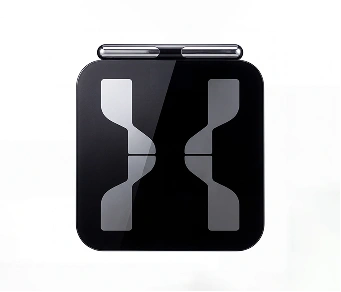
The Hume Pod is a home scale built around bioelectrical impedance analysis, using eight sensors instead of the two or four found on many basic smart scales. You stand barefoot on the Pod and hold a set of handles with your thumbs on the sensors positioned above waist height, which lets it send a small signal through more of your body than a floor-only scale can manage. From that signal, the Pod estimates weight, body fat percentage, muscle mass, and water levels, and its multi-frequency technology is built to separate extracellular from intracellular water rather than reporting one combined hydration number. It also breaks results down by body segment, arms, legs, and torso, and the company states the device tracks more than 45 metrics in total. The Hume Band, a separate wearable, covers different ground: daily step counts, sleep duration and architecture, and heart rate through a PPG sensor, positioned by Hume Health around long-term health tracking rather than a single body composition snapshot.
How the Numbers Get Turned Into Advice
A free tier of the Hume Health app covers basic weigh-ins and the core body composition numbers the Pod produces. The paid Hume Plus subscription adds a weekly Health Score out of 900, personalized insights, a baseline the company calls your Digital Twin, goal-based milestones, and nutrition challenges layered on top of the raw measurements. The app also syncs with Apple Health and Google Fit, so the numbers don't have to live only inside Hume Health's own ecosystem if you already track other data elsewhere. This two-tier structure means the hardware purchase gets you the measuring device and basic numbers, while the ongoing coaching layer, the part that turns a number into a recommendation, is a separate recurring decision rather than something bundled permanently into the Pod itself.
What Hume Health Says About Accuracy
To its credit, Hume Health is unusually direct about the limits of its own technology. The company's own FAQ states that every measurement is an estimate derived from a physical signal through a model, not a direct chemical or cellular assay the way a DEXA scan or lab blood test would be. It also acknowledges that bioelectrical impedance accuracy varies depending on your hydration state, your body type, and how closely you resemble the population the underlying model was built from. The company's own recommendation is to measure at a consistent time, in the morning, before eating, and to pay attention to the trend over weeks rather than treating any single reading as a precise, final number. That kind of transparency is not universal in the wearable and smart-scale category, and it's a useful thing to keep in mind when deciding how much weight to put on any one Hume Pod reading.
The GLP-1 Research Hume Health Publishes
Hume Health has published an internal outcomes analysis covering 6,990 of its members who were on GLP-1 therapy, the category of medication that includes drugs like semaglutide. The company reports a weighted mean lean mass loss of 16.9% among that group, which it positions as meaningfully below the 25% to 39% lean mass loss range cited in some published clinical trials on GLP-1 treatment. It's important to be precise about what this is: it's Hume Health's own analysis of its own user base using its own devices, not an independent, peer-reviewed study appearing in a medical journal. For someone already using GLP-1 medication under a doctor's supervision, this kind of data can be an interesting extra reference point for tracking lean mass alongside weight loss, but it is not a substitute for guidance from the physician actually managing that treatment.
Buying, Warranty, and What It Costs to Keep Using It
Hume Health advertises free shipping and the free basic app tier as included with the hardware purchase. The coaching features under Hume Plus, the weekly Health Score, personalized insights, and nutrition challenges, sit behind a separate ongoing subscription rather than being included permanently with the hardware. Anyone comparing the sticker price of the Pod itself against a basic smart scale should factor in that the full feature set Hume Health advertises in its marketing isn't entirely available without that additional subscription.
Who Should Buy It, and Who Should Pass
The Hume Pod is a reasonable fit for people who already weigh in regularly and want more than a single number, specifically segmental detail broken down by body part rather than one combined weight reading. It also suits people who are comfortable reading a trend line over weeks rather than reacting to every individual measurement, since the company's own FAQ is explicit that single readings are estimates. People managing a weight-related treatment under medical supervision may find it useful as an additional data point between appointments, though it should never replace what a doctor is tracking directly. It's a weaker fit for anyone who wants a simple scale and nothing more, anyone who finds frequent biometric numbers stressful rather than motivating, or anyone who needs certified, lab-grade body composition data for an actual clinical decision, since Hume Health itself points out that bioelectrical impedance is an estimate rather than a direct measurement.
Common questions
How accurate is the Hume Pod compared to a clinic test?
Hume Health is explicit that every reading is a modeled estimate from a bioelectrical signal, not a direct chemical or cellular measurement like a DEXA scan. Accuracy is best used for tracking your own trend over weeks and months rather than treating one reading as an exact lab result.
Do I need the Hume Plus subscription to use the Pod?
No. The free app tier covers basic weigh-ins and the core body composition numbers. The subscription adds the weekly Health Score, personalized insights, goal milestones, and nutrition challenges on top of what the free tier already measures.
What does the Hume Band track that the Pod doesn't?
The Pod is a stationary scale you step on periodically. The Hume Band is worn throughout the day and adds continuous step counts, sleep duration and architecture, and heart rate through a PPG sensor, none of which the Pod can capture on its own.
Is the 10-year warranty worth adding at checkout?
It depends on how long you plan to keep the device. The warranty covers hardware and sensor issues plus on-request recalibration for a decade, which matters more if you intend to use the Pod as a long-term tracking tool rather than trying it for just a few months.